

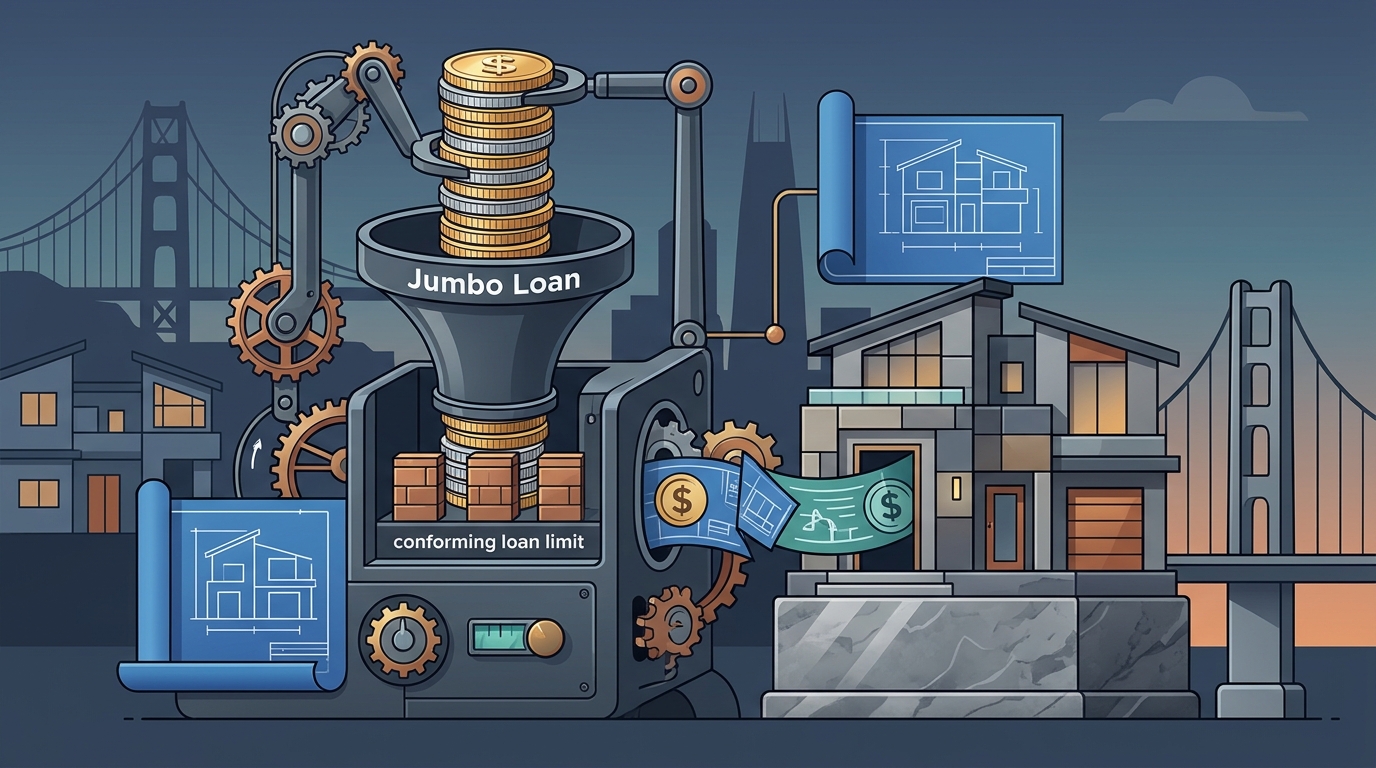
Buying a luxury home in the San Francisco Bay Area often requires financing that exceeds standard conforming limits. A jumbo loan is a mortgage that exceeds the conforming loan limits set by the Federal Housing Finance Agency (FHFA). Because Bay Area property values frequently surpass these caps, jumbo financing is the primary vehicle for high-end transactions. Philip Farr Properties guides clients through these complex structures, ensuring they understand the distinct underwriting standards, higher down payment requirements, and interest rate dynamics that define this tier of the market.
The Conforming Limit and the Jumbo Threshold
For buyers targeting properties in neighborhoods like Pacific Heights or Presidio Heights, the purchase price often places them well into jumbo territory. Even if a buyer makes a substantial down payment, the remaining loan balance may still exceed the local conforming cap. This classification triggers a different set of lender requirements. Jumbo loans are not backed by GSEs, meaning the bank or lender retains the risk. This risk retention is the primary driver behind the stricter qualification criteria and often higher interest rates associated with these loans.
Underwriting Standards and Documentation
Jumbo loan underwriting is significantly more rigorous than standard mortgage processing. Lenders typically require a higher credit score, often 740 or above, to mitigate the risk of holding a larger loan. Additionally, debt-to-income (DTI) ratios are scrutinized more closely. While conforming loans may allow a DTI of up to 45% or 50% with compensating factors, jumbo lenders often prefer a DTI below 36% or 40%. This means borrowers must demonstrate a stable, high income relative to their total monthly debt obligations.
Interest Rates and Pricing Dynamics
Interest rates on jumbo loans are generally higher than those on conforming loans. This rate premium reflects the higher risk the lender assumes by not selling the loan to a GSE. The spread between jumbo and conforming rates can vary based on market conditions, the borrower's credit profile, and the loan-to-value (LTV) ratio. A lower LTV, achieved through a larger down payment, can help secure a more competitive rate.
Buyers should also consider the type of rate structure. Fixed-rate jumbo loans provide payment stability, which is often preferred for long-term holds. Adjustable-rate mortgages (ARMs) are less common in the jumbo space but can offer lower initial rates. However, the risk of rate adjustments makes them less suitable for buyers planning to stay in the home for more than five to seven years. Understanding these pricing dynamics is crucial for budgeting accurately in the Bay Area's competitive market.
Bay Area Market Specifics and Implications
Furthermore, the competitive nature of the Bay Area market means buyers need to be prepared to act quickly. Having a pre-approval for a jumbo loan can strengthen an offer. However, the pre-approval process for jumbo loans is more time-consuming and detailed than for conforming loans. Buyers should start this process early to ensure their financing is solid before making an offer. Philip Farr Properties works with clients to align their financing strategy with their property search, ensuring they are positioned to move decisively when the right opportunity arises.
Key Takeaways
- Jumbo loans exceed the FHFA conforming limits, which are higher in Bay Area counties than the national baseline.
- Underwriting for jumbo loans is stricter, typically requiring higher credit scores and lower debt-to-income ratios.
- Down payment requirements for jumbo loans are generally higher, often ranging from 20% to 30%.
- Interest rates on jumbo loans are usually higher than conforming rates due to the lack of GSE backing.
- Liquidity is a critical factor; lenders require proof of liquid assets for down payments and reserves.
- Pre-approval for jumbo loans is a more detailed process and should be initiated early in the search.
Frequently Asked Questions
What is the conforming loan limit in San Francisco in 2026?
The conforming loan limit in high-cost areas like San Francisco is significantly higher than the national baseline. In 2026, the limit for these areas is approximately $1.2 million. Any loan amount above this figure is considered a jumbo loan.
Do jumbo loans require a higher down payment?
Yes, jumbo loans typically require a larger down payment than conforming loans. While conforming loans may allow as little as 3% to 5% down, jumbo lenders usually require 20% to 30% to mitigate their risk.
Can I use stock options for a jumbo loan down payment?
Generally, no. Lenders require liquid assets for down payments. Stock options are considered illiquid and are not accepted as source of funds for the down payment, though they may be considered in the overall financial picture for income verification.
Are jumbo loan interest rates fixed or adjustable?
Most jumbo loans are fixed-rate, providing payment stability. Adjustable-rate options exist but are less common and carry the risk of future rate increases. Fixed rates are preferred for long-term ownership.
How long does jumbo loan pre-approval take?
Jumbo loan pre-approval is more detailed than standard pre-approval and can take several weeks. It involves a thorough review of tax returns, bank statements, and income documentation. Starting this process early is essential for competitive offers.
Strategic Financing for Luxury Buyers
Navigating jumbo loan financing requires a strategic approach that aligns with your long-term financial goals. Understanding the mechanics of these loans, from conforming limits to underwriting standards, empowers you to make informed decisions. Philip Farr Properties provides expert guidance on financing options, helping you structure your offer with confidence. To discuss your financing strategy and explore luxury properties in the Bay Area, contact our team.